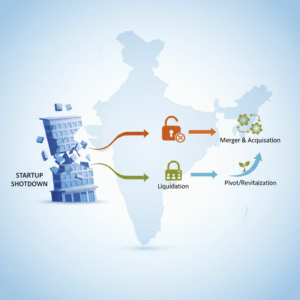

Nearly three out of four new businesses collapse because they bleed cash. The method you select for winding down your company under the Insolvency and Bankruptcy Code, or IBC, is crucial. I have observed numerous companies grapple with the decision between a Strike Off and Voluntary Liquidation. Although both paths lead to the same destination the business is closed the procedures, stipulations and ramifications differ significantly. To guarantee a seamless and legally compliant exit, directors and stakeholders must fully grasp these nuances. Therefore, a solid understanding of the Strike Off versus Voluntary Liquidation is critical.
Understanding Strike Off
Section 248 of the Companies Act, 2013, details the Strike Off process. It offers a quicker, more straightforward route to business closure. I typically suggest this approach for companies that are dormant, have ceased operations and possess minimal assets and debts.
Strike Off Requirements
To qualify for a Strike Off, a company must satisfy particular criteria. The following conditions must be true:
- The company must not have conducted any business in the prior two years or since its inception.
- The company must have no outstanding debts, including unpaid taxes and statutory obligations.
- All company bank accounts must be closed.
- The company must have filed all mandatory statutory returns, such as annual returns and financial statements, up to the application date.
Strike Off: The Steps
The Strike Off process generally involves these steps:
- Board Approval: The board of directors must authorize the Strike Off application by passing a resolution.
- Application to the Registrar of Companies, or ROC: The company submits an application to the ROC using Form STK-2, together with all necessary fees and documentation.
- Public Notice: The ROC publishes a public notice to invite any objections to the Strike Off.
- Removal from Register: If there are no objections, the ROC strikes the company’s name from the register, dissolving the company.
Understanding Voluntary Liquidation
Voluntary Liquidation, as defined in Section 59 of the IBC, is a more formalized process and is best suited for companies possessing both assets and debts. I have often seen this method preferred when a solvent company seeks to discontinue operations for strategic reasons. This is another avenue for company closure under IBC.
Voluntary Liquidation Requirements
A company can initiate Voluntary Liquidation if it fulfills these conditions:
- The company must be solvent, meaning it can fully discharge its debts using proceeds from the sale of its assets.
- The majority of directors must affirm the company’s ability to settle its debts.
- Shareholder approval is required, typically through a special resolution approved by at least three fourths of the votes.
Voluntary Liquidation: The Steps
The Voluntary Liquidation process includes these essential phases:
- Solvency Declaration: The directors declare solvency, supported by a valuation report of the company’s assets.
- Shareholder Approval: The shareholders approve Voluntary Liquidation through a special resolution.
- Liquidator Appointment: An insolvency professional is designated as the liquidator to oversee the liquidation process.
- Public Notice: A public notice is disseminated to solicit creditor claims.
- Asset Realization and Distribution: The liquidator liquidates the assets and distributes the proceeds to creditors and shareholders, adhering to IBC guidelines.
- Dissolution: Once all assets are liquidated and distributions are finalized, the liquidator petitions the NCLT, or National Company Law Tribunal, for a dissolution order.
Strike Off Versus Voluntary Liquidation: Core Differences
Here is a summary highlighting the key distinctions between Strike Off and Voluntary Liquidation:
- Complexity and Time: Strike Off is simpler and faster, whereas Voluntary Liquidation is more intricate and time intensive. I have seen Strike Offs finalized in months, compared to a year or longer for Voluntary Liquidations.
- Requirements: Strike Off is appropriate for inactive companies possessing very few assets and debts. Voluntary Liquidation is suitable for solvent companies that hold assets and debts necessitating management and distribution.
- Process: Strike Off entails applying to the ROC, whereas Voluntary Liquidation mandates a more formalized IBC process, including liquidator appointment and NCLT approval.
- Cost: Strike Off is generally less costly than Voluntary Liquidation because it is less complicated and entails lower professional fees.
- Compliance: Voluntary Liquidation demands stricter compliance, with extensive reporting and adherence to IBC rules.
When to Use Strike Off
Consider Strike Off when these statements are true:
- The company is dormant and has no intention of resuming operations.
- The company has very few assets and debts.
- The directors desire a swift and economical method to close the company.
- The company satisfies all requirements under Section 248 of the Companies Act, 2013.
When to Use Voluntary Liquidation
Voluntary Liquidation is often the superior choice when:
- The company is solvent, possessing assets and debts that necessitate proper management and distribution.
- The directors seek to adhere to IBC rules and avert potential liabilities.
- The company requires a structured process to manage creditor claims and shareholder interests.
- The company foresees potential disputes or legal challenges during closure.
The Importance of Professional Guidance
Grasping Strike Off and Voluntary Liquidation necessitates a firm understanding of legal and regulatory structures. I strongly advocate seeking professional counsel from seasoned insolvency professionals, chartered accountants or company secretaries. These specialists can evaluate your company’s specific circumstances, propose the optimal closure method and shepherd you through the entire process. The decision of Strike Off versus Voluntary Liquidation is pivotal.
Avoiding Potential Problems
Both Strike Off and Voluntary Liquidation present potential pitfalls that companies should acknowledge:
- Strike Off: Applying for Strike Off with outstanding debts or noncompliance with statutory rules risks application rejection and potential penalties. I have seen directors encounter legal ramifications for misrepresentation.
- Voluntary Liquidation: Neglecting to meet solvency requirements or properly manage the liquidation process can generate legal issues and liabilities for directors.
Recent Amendments and Case Law
The IBC and Companies Act are subject to revisions and judicial interpretations. Remaining informed about the most recent modifications is vital for compliance. I diligently monitor these revisions and advise my clients. This guarantees appropriate company closure under IBC.
For instance, recent amendments have simplified the Voluntary Liquidation process for particular company classifications, such as startups and small businesses. Additionally, numerous case laws have clarified liquidator responsibilities and creditor rights during Voluntary Liquidation proceedings.
Takeaway
Choosing between Strike Off and Voluntary Liquidation demands careful assessment of your company’s unique situation. While Strike Off presents a more streamlined path for closing dormant companies, Voluntary Liquidation furnishes a structured framework for managing assets and debts of solvent companies. Securing professional guidance and staying current on the latest legal and regulatory modifications are indispensable for a successful and compliant company closure. By comprehending the specifics of each option, you can make a well-informed decision for your company and ensure a seamless transition. The core decision revolves around Strike Off vs Voluntary Liquidation.